By Dr. Donald Spears, ND, MSOM, LAc Whole Systems Healthcare Boulder
When most people think about declining testosterone, they think about aging. And it’s true that testosterone levels tend to change as men get older.
But researchers have noticed something interesting: testosterone levels appear to be declining in younger men, too.
One study looked at testosterone levels in adolescent and young adult men in the United States between 1999 and 2016. Researchers found that average testosterone levels declined over that period, even after accounting for changes in body weight.¹ An earlier study following American men over time found a similar population-level decline that couldn’t be fully explained by aging, obesity, smoking, or other measured health factors.²
That doesn’t mean every young man today has low testosterone, and these studies don’t tell us exactly why average levels have changed.
But they raise an interesting question:
What is happening in men’s health that might be influencing testosterone?
The answer is more complicated than any one food, chemical, nutrient, or lifestyle habit.
Testosterone Is Part of a Much Bigger System
It’s easy to think about testosterone as something produced by the testicles.
Technically, that’s true. But your testicles don’t decide on their own how much testosterone to make.
Your brain is involved.
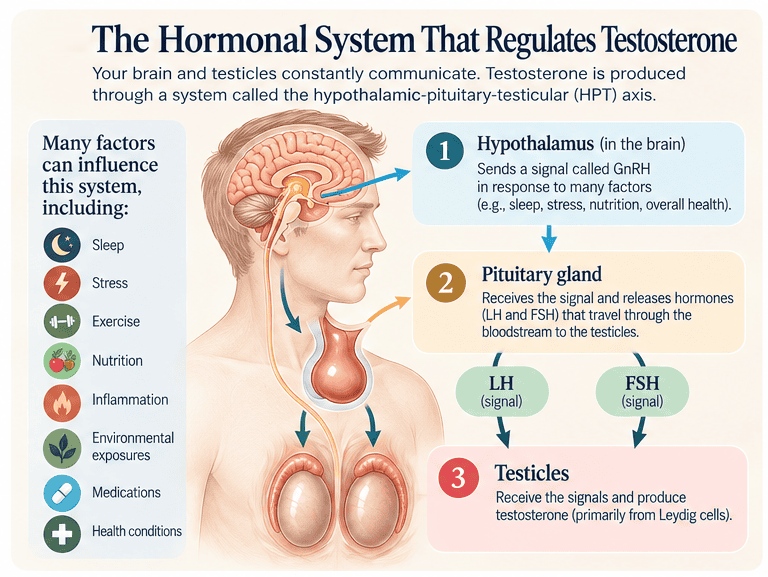
The process begins in an area of the brain called the hypothalamus. The hypothalamus communicates with the pituitary gland, which then sends signals to the testicles telling them to produce testosterone.
This communication network is referred to as the hypothalamic-pituitary-testicular axis, or HPT axis and what it tells us is that testosterone production depends on communication between several different parts of the body.
That means a low testosterone result doesn’t necessarily tell us why testosterone is low.
The problem could be primarily in the testicles. It could involve signals coming from the brain or pituitary. Or testosterone could be influenced by something happening elsewhere in the body.³
That’s why when assessing this hormone, it is best to look at more than just an isolated number.
There Probably Isn’t One “Root Cause”
Imagine two men who both have low testosterone.
The first sleeps five hours a night, works a high-stress job, rarely exercises, and has developed insulin resistance.
The second exercises regularly, sleeps well, eats a nutritious diet, but has a medical condition affecting his pituitary gland.
Their laboratory reports might show a similar testosterone number.
But these are clearly not the same patient.
This is one reason I tend to avoid the phrase “root cause.” Human health is rarely a matter of finding one hidden problem responsible for everything else.
More often, we’re looking at multiple contributing factors and asking how they fit together.
With testosterone, those factors can include sleep, metabolic health, body composition, stress, medications, illness, nutrition, alcohol use, and potentially certain environmental exposures.
The goal isn’t simply to ask, “How can we make this testosterone number higher?”
I think the better question is:
“Why might this man’s body be producing this testosterone level in the first place?”
When we start asking that question, several patterns begin to emerge.
Research points to a number of factors that may influence testosterone production and the larger hormonal system that regulates it. Some, like sleep and metabolic health, have relatively strong evidence behind them. Others, including oxidative stress and certain environmental exposures, are still being explored.
These factors can also overlap and influence one another, which is why it is helpful to look at them as pieces of a larger picture rather than isolated causes.
Let’s look at some of the major contributors researchers are investigating.
Sleep Can Affect Testosterone
Sleep is one of the first things I want to understand when I’m evaluating a man’s hormonal health.
In a small study, researchers allowed 10 healthy young men to sleep only five hours per night for one week. Their daytime testosterone levels were about 10% to 15% lower after the period of sleep restriction.⁴
That doesn’t mean sleeping more will automatically correct low testosterone. And because this was a very small study, we shouldn’t assume every man will respond exactly the same way.
But it illustrates an important point:
Sleep and hormones are connected.
So when a patient comes to me concerned about testosterone, I want to know what his nights actually look like.
Is he getting enough sleep? Does he wake up rested? Does he snore? Is he waking frequently? Does he work late into the night? Is his sleep schedule completely different on the weekends?
Those questions can be just as relevant to the larger picture as the testosterone result itself.
Metabolic Health Matters, Too
Another strong relationship exists between testosterone and metabolic health.
Studies have found that lower testosterone is more common in men with obesity, insulin resistance, metabolic syndrome, and type 2 diabetes.⁵˒⁶
But even here, the story isn’t as simple as saying, “Being overweight causes low testosterone.”
Body fat is biologically active tissue. It influences hormones, inflammation, insulin signaling, and the way testosterone and estrogen are processed in the body.
And the relationship can go in both directions. Changes in testosterone can affect body composition and metabolism, while metabolic changes can affect testosterone.
This is what I mean when I talk about Whole Systems healthcare.
Instead of separating a man’s weight, blood sugar, cardiovascular health, energy, sleep, and hormones into completely different boxes, we look at the relationships between them.
What Does Stress Have to Do With Testosterone?
Probably more than many men realize.
When I use the word stress, I’m not talking only about feeling worried.
Your body experiences many forms of stress: psychological stress, sleep deprivation, illness, inflammation, excessive training, inadequate nutrition, and metabolic dysfunction are all different kinds of physiological demands.
Your brain is continually receiving information about what’s happening throughout your body and environment. Some of the same areas of the brain involved in regulating your stress response also communicate with your reproductive system.
Experimental research helps us understand how interconnected these systems may be. Scientists have found that inflammation and stress hormones can alter some of the brain signals involved in reproductive hormone regulation.⁷⁻⁹
Most of this detailed mechanistic research has been done in animals or cells rather than directly in men, so we need to be careful about how far we take it.
But the larger idea makes sense:
Your hormonal system is listening to the rest of your body.
Hormones don’t operate in isolation from the way you sleep, eat, move, recover, and experience stress.
Oxidative Stress and Testosterone
This is where we’re going to stretch the science slightly for readers who want to understand what’s happening beneath the surface.
You may have heard the term oxidative stress.
Our bodies constantly produce molecules called reactive oxygen species, or ROS. They’re often portrayed as something bad that antioxidants need to eliminate, but that’s not really accurate.
In small, controlled amounts, ROS actually help cells communicate.
Problems can occur when the production of these molecules overwhelms the body’s ability to keep them in balance. That’s what we mean by oxidative stress.
Researchers have found that this balance may matter at several points in the system that regulates testosterone.
Studies suggest excessive oxidative stress can affect the brain cells involved in initiating reproductive hormone signals.¹⁰ Other research suggests it can interfere with normal signaling in the pituitary gland.¹¹˒¹² And at the level of the testicles, oxidative stress can interfere with the function of Leydig cells, the cells responsible for producing testosterone.¹³˒¹⁴
Much of this research comes from animal and laboratory studies. We cannot conclude from it that oxidative stress is the reason testosterone levels are declining in younger men.
But it gives us another clue that testosterone production reflects what’s happening throughout a much larger biological system.
Interestingly, this research also tells us that the answer isn’t simply to take as many antioxidants as possible. Some oxidative signaling is necessary for normal hormone function.¹¹˒¹²
As is so often true in physiology, balance matters more than simply having more or less of something.
What About Chemicals in Our Environment?
Environmental exposures are another area getting considerable attention in men’s reproductive health research.
You may have heard the term endocrine-disrupting chemicals, or EDCs. These are chemicals that can interact with the body’s hormonal systems.
One well-studied group is called phthalates. They’re used in many plastics, personal-care products, packaging, and other consumer goods. Researchers have found associations between exposure to certain phthalates and differences in reproductive hormone levels in men.¹⁵
Other chemicals being studied include BPA and related bisphenols, polyfluoroalkyl substances (PFAS), certain pesticides, and some heavy metals.
This is an area where I think we need to be particularly careful about fear-based health information.
Finding an association doesn’t necessarily mean a particular chemical caused one man’s low testosterone. We’re exposed to many things simultaneously, and the evidence is much stronger for some exposures than others.
You also don’t need to live in a bubble.
But this research reminds us of something that’s easy to forget:
Our bodies don’t exist separately from our environment.
What we eat, breathe, drink, put on our skin, and encounter in our surroundings becomes part of the environment in which our physiology operates.
One Low Testosterone Result Doesn’t Tell the Whole Story
If you’ve had one blood test showing low testosterone, that doesn’t necessarily mean you have testosterone deficiency or that you need testosterone therapy.
Current clinical guidelines recommend diagnosing hypogonadism when a man has symptoms consistent with testosterone deficiency and repeatedly low testosterone levels. Testosterone should generally be checked in the morning, and an initially low result should be confirmed with another morning measurement.³
If testosterone remains low, other hormones can help us understand the pattern.
For example, LH and FSH are hormones produced by the pituitary gland that communicate with the testicles. Looking at those alongside testosterone can help determine whether the pattern appears to be coming primarily from the testicles or from signaling higher up in the system.³
Depending on the individual, I may also want to understand his sleep, blood sugar regulation, cardiovascular health, medications, body composition, stress, nutrition, and other symptoms.
In other words, the number matters, but so does the person who produced the number.
What About Testosterone Replacement Therapy?
Testosterone replacement therapy, or TRT, can be an appropriate treatment for some men with properly diagnosed testosterone deficiency.
But treatment shouldn’t begin with the assumption that every low or low-normal testosterone result needs to be pushed higher.
We first need to understand the clinical picture.
This is especially important for younger men who want to have children. Taking testosterone from outside the body can suppress the hormonal signals necessary for sperm production, which is why current clinical guidelines recommend against starting testosterone therapy in men who are planning fertility in the near future.³
That’s an important conversation to have before starting treatment.
For some men, testosterone therapy may ultimately make sense. For others, there may be other areas of health that deserve attention first.
So What Can Men Actually Do?
After reading about declining testosterone, endocrine-disrupting chemicals, oxidative stress, and metabolic health, it would be easy to feel like men’s hormonal health requires an incredibly complicated protocol.
I don’t think that’s the right takeaway.
Some of the most important questions are surprisingly foundational.
How are you sleeping?
Are you physically active and maintaining muscle?
How is your blood sugar and metabolic health?
Are you eating enough nutrient-dense food?
How much alcohol are you drinking?
How well are you recovering from exercise?
What does your stress load look like?
Are any medications or health conditions affecting your hormones?
And are there reasonable ways to reduce unnecessary environmental exposures?
Those questions aren’t as exciting as a supplement promising to “boost testosterone.”
But they’re often much more useful.
And if testosterone truly is low, the next step isn’t necessarily guessing which supplement to take.
It’s figuring out why.
Men’s Health Is Bigger Than Testosterone
A man may initially come to see me because he’s tired, has lost motivation, isn’t recovering from exercise the way he used to, has noticed changes in libido or sexual function, or simply doesn’t feel like himself.
Sometimes testosterone is part of that picture.
Sometimes it isn’t.
My job as a holistic doctor isn’t to force every symptom into a testosterone diagnosis or simply try to push a laboratory number higher.
It’s to understand the person sitting in front of me.
That means looking at his symptoms, history, hormones, metabolism, sleep, cardiovascular health, digestion, stress, lifestyle, and environment and asking how those pieces may relate to one another.
That’s what Whole Systems means to me.
We aren’t just asking how to change the number.
We’re trying to understand the system that produced the number in the first place.
About Dr. Spears
Dr. Donald Spears, ND, MSOM, LAc practices at Whole Systems Healthcare Boulder, where he works with men interested in a holistic approach to their health, including hormonal, cardiovascular, gastrointestinal, and nervous-system concerns.
This article is for educational purposes and is not intended to diagnose or treat an individual medical condition.
References
Lokeshwar SD, Patel P, Fantus RJ, et al. Decline in serum testosterone levels among adolescent and young adult men in the USA. Eur Urol Focus. 2021;7(4):886-889. doi:10.1016/j.euf.2020.02.006.
Travison TG, Araujo AB, O’Donnell AB, Kupelian V, McKinlay JB. A population-level decline in serum testosterone levels in American men. J Clin Endocrinol Metab. 2007;92(1):196-202. doi:10.1210/jc.2006-1375.
Bhasin S, Brito JP, Cunningham GR, et al. Testosterone therapy in men with hypogonadism: an Endocrine Society clinical practice guideline. J Clin Endocrinol Metab. 2018;103(5):1715-1744. doi:10.1210/jc.2018-00229.
Leproult R, Van Cauter E. Effect of 1 week of sleep restriction on testosterone levels in young healthy men. JAMA. 2011;305(21):2173-2174. doi:10.1001/jama.2011.710.
Dhindsa S, Miller MG, McWhirter CL, et al. Testosterone concentrations in diabetic and nondiabetic obese men. Diabetes Care. 2010;33(6):1186-1192. doi:10.2337/dc09-1649.
Wu FCW, Tajar A, Beynon JM, et al. Identification of late-onset hypogonadism in middle-aged and elderly men. N Engl J Med. 2010;363(2):123-135. doi:10.1056/NEJMoa0911101.
Iwasa T, Matsuzaki T, Murakami M, et al. Decreased expression of kisspeptin mediates acute immune/inflammatory stress-induced suppression of gonadotropin secretion in female rat. J Endocrinol Invest. 2008;31(7):656-659. doi:10.1007/BF03345620.
Castellano JM, Bentsen AH, Romero M, et al. Acute inflammation reduces kisspeptin immunoreactivity at the arcuate nucleus and decreases responsiveness to kisspeptin independently of its anorectic effects. Am J Physiol Endocrinol Metab. 2010;299(1):E54-E61. doi:10.1152/ajpendo.00081.2010.
Iwasa T, Matsuzaki T, Yano K, Mayila Y, Irahara M. The roles of kisspeptin and gonadotropin inhibitory hormone in stress-induced reproductive disorders. Endocr J. 2018;65(2):133-140. doi:10.1507/endocrj.EJ18-0026.
Rijal S, Jang SH, Cho DH, Han SK. Hydrogen peroxide suppresses excitability of gonadotropin-releasing hormone neurons in adult mouse. Front Endocrinol (Lausanne). 2022;13:939699. doi:10.3389/fendo.2022.939699.
Armstrong SP, et al. SRXN1 is necessary for resolution of GnRH-induced oxidative stress and induction of gonadotropin gene expression. Endocrinology. 2019;160(11):2543-2555. doi:10.1210/en.2019-00309.
Diemer T, Allen JA, Hales KH, Hales DB. Reactive oxygen disrupts mitochondria in MA-10 tumor Leydig cells and inhibits steroidogenic acute regulatory (StAR) protein and steroidogenesis. Endocrinology. 2003;144(7):2882-2891. doi:10.1210/en.2002-0090.
Allen JA, Diemer T, Janus P, Hales KH, Hales DB. Bacterial endotoxin lipopolysaccharide and reactive oxygen species inhibit Leydig cell steroidogenesis via perturbation of mitochondria. Endocrine. 2004;25(3):265-275. doi:10.1385/ENDO:25:3:265.
Duty SM, Calafat AM, Silva MJ, Ryan L, Hauser R. Phthalate exposure and reproductive hormones in adult men. Hum Reprod. 2005;20(3):604-610. doi:10.1093/humrep/deh656.